

MOHRE Domestic Worker Gratuity & Compliance Guide (2026)
If you are living in the UAE and employ a domestic worker, whether it is a nanny, a driver, or a private tutor, you have probably heard about “gratuity.”Let’s be real, years ago, things were simpler. When a helper was leaving, you did some math, handed over cash, and said a warm goodbye. But by 2026, things have changed. You can’t just grab a basic calculated salary and be done with it anymore.
A new law, Federal Decree-Law No. 9 of 2022, has shifted the ground for everyone. Hiring help for your home now means following a more complex system. Honestly, it can feel a bit heavy. It’s not only about a handshake at the end (though that still counts). You now need to handle Wage Protection System rules and understand the new Voluntary Savings Scheme.
Does all of this feel like a lot to take in? You are not alone. Many employers are trying to figure out their duties. They want to be fair to their helpers, both in spirit and by the book. This guide is here to help clarify things.
Who Qualifies? The 19 Categories of Domestic Staff
A common mistake many employers make is thinking that “domestic worker” only refers to housemaids. In reality, the UAE Ministry of Human Resources and Emiratisation (MOHRE) recognizes a broad spectrum of roles. If you hire someone to work within your private home or for your family’s personal needs, they likely fall into one of these categories.
- Housemaid: General cleaning and household management
- Security Guard: Protecting the private villa or property
- Personal Trainer: Helping family members stay healthy and active
- Falconer: Caring for and training birds of prey, a unique tradition
- Private Tutor: Bringing education directly to children at home
- Household Manager: Making sure the home runs smoothly, day in and day out
- Personal Chef: Creating meals tailored to dietary needs and preferences
- Nanny / Babysitter: Nurturing children with attention and early learning
- Estate Farmer: Tending private gardens and growing produce
- Skills Coach: Offering specialized training in sports or other disciplines
- Gardener: Designing and nurturing landscapes and green spaces
- Groundskeeper / Handyman: Keeping the estate in top shape with daily upkeep
- Private Nurse: Providing medical care and comfort to family members
- Executive Assistant: Organising schedules, appointments, and daily needs
- Driver / Chauffeur: Ensuring safe, reliable transportation for the family
- Shepherd / Livestock Keeper: Looking after animals on private land
- Yacht Crew / Captain: Handling navigation and care of private vessels
- Agricultural Specialist: Applying technical expertise to private farming
- Household Coordinator: Managing staff and vendors so everything flows smoothly
Why the Category Matters
The law protects all categories equally, but their salary structures vary. A Private Nurse or Personal Assistant, for example, will usually have a much higher Basic Salary compared to a general helper. Since gratuity is calculated strictly on the “Basic” portion of the wage (excluding food or housing allowances), knowing the exact breakdown in the contract is the first step toward a correct calculation.
The 2026 Legal Reality: 14 Days vs. 21 Days
There is a significant “legal gap” that often confuses people. Many websites still quote the old 2017 law, which explicitly stated that domestic workers get 14 days of pay per year. However, Federal Decree-Law No. 9 of 2022 (and its subsequent 2024 updates) handled this differently.
The “Silent” Law (The Historical Standard)
The new rule in 2026 is simple. No more monthly payments during your job. You only pay when you leave. At that time, you make a single payment based on the worker’s basic wage.
- If they have served at least 1 year: You pay 14 days of basic salary for every year.
- If they have served partial years: You pay a pro-rata amount for every extra month. This system is great because it follows the traditional MOHRE benchmark for domestic staff, and it gives your worker a significant financial reward for their years of loyalty.
The Voluntary Savings Scheme (The 2026 Alternative)
One thing you’ll want to mark on your calendar for 2026 is a major shift in how end-of-service benefits work. There’s a new option on the table that gives employees more choice when they move on from a job. Instead of waiting until the end of the contract to pay a huge lump sum, you can now enrol your helper in a professional investment fund.
- If they have served less than 5 years: You pay 5.83% of their basic salary every month.
- If they have served more than 5 years: You pay 8.33% of their basic salary every month. This system is great because it protects you from having to pay a massive amount all at once, and it gives your worker the chance to see their money grow through safe investments.
How to Calculate Gratuity: Standard & Pro-Rata Math
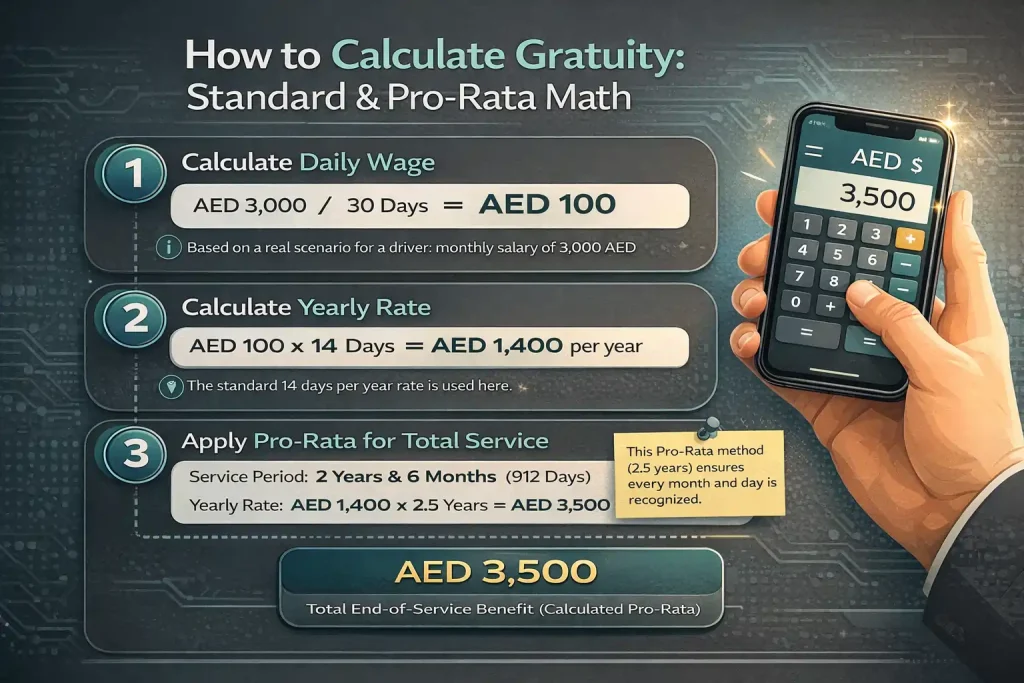
Calculating gratuity does not have to be a headache. Should you not be enrolled in the monthly Savings Scheme, you will likely follow the traditional “14-day” rule.
The Basic Formula
To figure out the total, you’ll first need the Daily Basic Wage. You can get that by dividing the monthly basic salary by 30.
Daily Basic Wage=Monthly Basic Salary/30
This brings us to the final formula.
(Daily Basic Wage×14)×(Total Days Served÷365)
Scenario: A Personal Driver Case Study
Take a real situation. There’s a driver who’s been driving for one family for 2 years and 6 months now, which works out to 912 days on the job. His monthly basic salary is AED 3,000.
- Find Daily Wage: 3,000 /30 = AED 100.
- Calculate Yearly Rate: 100 X 14 = AED 1,400 per year.
- Pro-Rata Calculation: 1,400 X 2.5 = AED 3,500.
In this situation, the driver would receive AED 3,500 as his end-of-service benefit. This method makes sure that every single month and day he worked gets recognized nothing is left out.
5 Steps to Use the Domestic Worker Gratuity Calculator

Why wrestle with confusing numbers when our online tool does all the heavy lifting for you? It’s fast, accurate, and takes less than a minute. Here’s how to make it work for you:
- Pick Your Start Date: Grab your employment contract and find the exact day you began working. This matters more than you think because every single day of your service counts, right from the beginning.
- Enter Your End Date: Put in your last working day. This helps the calculator determine your total days of service, including partial years.
- Enter Your Basic Salary: Enter your monthly basic wage only. You don’t need to worry about adding extra for food or travel. Your gratuity is calculated strictly based on your “basic salary” only.
- Choose Your Reason for Leaving: This is an important step. Select if your contract ended as planned, if there was a breach from your employer, if you resigned, or if you were terminated. Your reason can change the final amount you receive.
- Get Your Result: Finally, by clicking “Calculate Gratuity.” The tool will show you the total amount you’re entitled to under UAE law.
JAFZA vs. Mainland: Does the Calculator Change?
If you live in a Free Zone area like the Jebel Ali Free Zone (JAFZA), you might wonder if the rules change. In 2026, the UAE has worked hard to unify labour laws, but there are still small administrative differences.
Mainland employers deal directly with MOHRE, whereas JAFZA-based employers often manage their staff through the JAFZA portal. However, for domestic staff, the standard “14-day” logic generally remains the same. The primary difference is usually where you file the paperwork and how the visa is cancelled. Always check your specific Free Zone’s “Staff Accommodation” or “Domestic Services” handbook to see whether it requires any additional insurance or fees.
WPS & Gratuity: Recording Your Payout Digitally
This is where many employers get into trouble. In 2026, the Wage Protection System (WPS) will no longer be just for big companies; it will be vital for household employers too.
Why You Shouldn’t Just Pay Cash
If you pay your helper AED 5,000 in cash as gratuity and don’t record it, the MOHRE system might still show you owe them money. This can lead to a “block” on your file, preventing you from renewing other visas or hiring new staff.
Using the Correct SIF Codes
When you make the final payment through your bank or a local exchange house, you must use a Salary Information File (SIF). This digital file contains specific codes. For a final gratuity payment, you should use the code for End of Service Benefit (often EOSB or GRT). This tells the government exactly what the payment is for, ensuring your record is cleared and you are fully compliant.
Reasons for Forfeiture: Absconding & Resignation
The law is designed to be fair to both sides. While workers are entitled to their pay, there are situations in which they might lose that right.
Resignation and Notice Periods
If a worker wants to leave, they must give the notice period stated in the contract (usually 30 days). If they leave without giving notice or valid reason, they are in “Worker Breach.” In some cases, this can lead to a reduction or loss of gratuity.
Absconding (Fleeing)
If a worker simply disappears without a word often called “absconding”; the employer must report this to MOHRE immediately. If a worker is officially marked as an absconder, they generally forfeit their right to gratuity.
The 10-Day Rule
But on the other hand, if the contract just runs its course, or you decide to end it. The law is pretty strict about this; you have to make sure all outstanding payments are settled within 10 days. Failure to do so can result in fines ranging from AED 5,000 to AED 20,000.
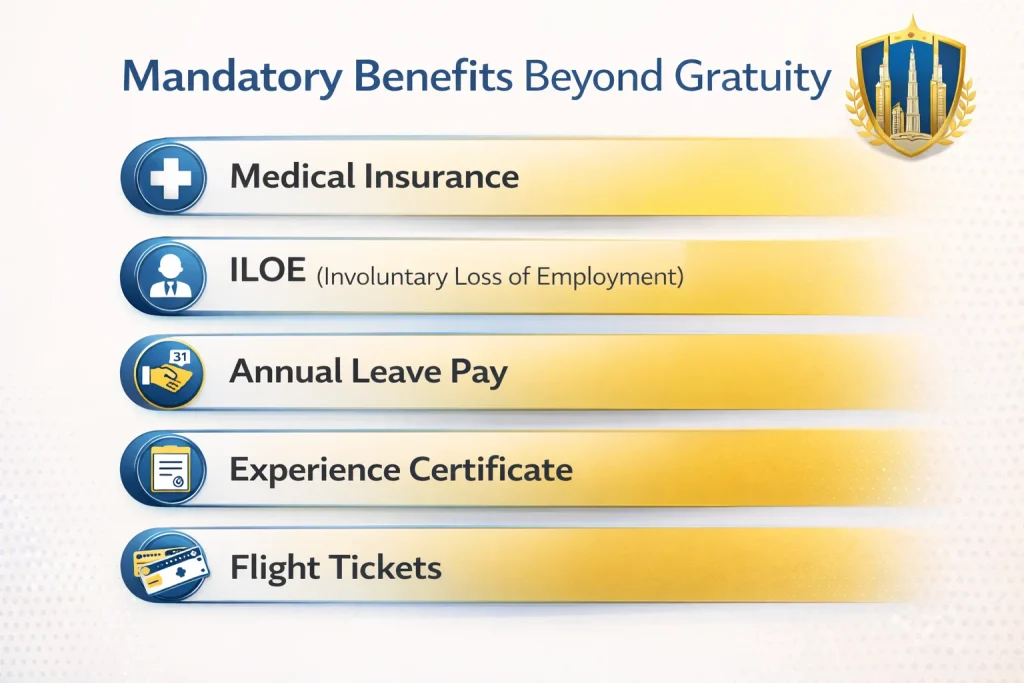
5 Mandatory Benefits Beyond Gratuity
At the end of the day, gratuity is only part of what makes a settlement feel complete. If you want to be an employer people love and trust in 2026, it’s about offering more than just numbers on a paycheck. It’s the little (and big) reassurances that their well-being and future with you truly matter. Beyond the workspace and the salary, your team needs to feel seen, secure, and valued for the long haul.
- Medical Insurance: Ensure you provide a valid health insurance card. In Dubai and Abu Dhabi, this is a strict requirement for visa renewal.
- ILOE (Involuntary Loss of Employment): By 2026, domestic workers must be subscribed to the UAE’s unemployment insurance. Ensure their premiums are up to date.
- Annual Leave Pay: If your worker has unused vacation days, you must pay them the cash equivalent in the final settlement.
- Experience Certificate: If they ask for one, please provide a simple letter confirming their role and employment dates. It doesn’t cost you anything, and it genuinely helps them land their next job.
- Flight Tickets: After every two years of service, you are legally required to provide a return ticket to your home country.
Conclusion
Acknowledging the responsibility of managing a household in the UAE is essential. However, accurately calculating end-of-service benefits under MOHRE guidelines goes beyond being a legal chore; it reflects your respect for those who support your family. By following Decree-Law No. 9 of 2022 and utilizing the WPS or Savings Scheme, you ensure full compliance and build lasting trust. Whether employing a JAFZA driver or a Downtown Dubai nanny, honouring their hard work creates a professional, positive relationship rooted in fairness and gratitude.
FAQS
Can I calculate gratuity manually?
Absolutely all you need to do is take your monthly basic salary, divide it by 30, and then multiply that number by 14 for every year you’ve worked.
How is gratuity calculated for maids in the UAE?
It is calculated by multiplying your basic salary by fourteen by the total number of years you have served.
What if I worked through an agency in the UAE?
If you are sponsored by a Tadbeer agency, the agency is legally responsible for paying your end-of-service benefits directly.
What is the new law for domestic workers in the UAE?
Federal Decree-Law No. 9 of 2022 mandates digital payment via WPS and offers an optional monthly savings scheme for workers.
What if the employer breaches the contract?
If the company violates the rules, the employee can report it to the Ministry of Human Resources (MOHRE) to claim their full gratuity and seek compensation.


