Emergency Leave in the UAE: The 2026 Comprehensive Guide
Life is famously unpredictable. One moment, you’re at your desk in Dubai or Abu Dhabi, handling your usual routine, and the next, you get that call, the one about a family emergency or a sudden health crisis that stops you in your tracks. In a heartbeat, your focus shifts completely. And when you’re already carrying that weight, the last thing you should have to worry about is your paycheck or whether your job will still be there when you get back.
The UAE labor landscape has shifted significantly as we move through 2026. With the introduction of the Voluntary Alternative End-of-Service Benefits Scheme (the Savings Scheme) and new binding powers given to the Ministry of Human Resources and Emiratisation (MoHRE), the old rules from 2021 are no longer the full story. This guide is designed to walk you through every nuance of emergency leave, ensuring you stay protected, paid, and compliant.
Key Takeaways
Here are the key things you should know about taking emergency time off in 2026.
- A “Hybrid” Entitlement: While “emergency leave” isn’t a single standalone article in the law, it is a combination of your rights under Article 33 (Labor Law) and your specific company’s internal policies.
- The AED 50,000 Rule: If you have a dispute with your boss over leave pay, overtime calculation errors, or a deduction that is less than AED 50,000, MOHRE now has the power to issue a binding decision within 14 days, skipping the long court process.
- The Savings Scheme Impact: If you take unpaid emergency leave, your employer is not required to make the monthly 5.83% or 8.33% contribution to your investment fund for those specific days.
- Mandatory 2026 Protocols: Following the climate shifts of recent years, MoHRE now mandates flexible or remote work during “unstable weather” emergencies, which differs from personal emergency leave.
What Is Emergency Leave in the UAE?
Technically speaking, if you search Federal Decree-Law No. 33 of 2021 for the phrase “Emergency Leave,” you won’t find a specific chapter dedicated to it. But in the UAE, emergencies are treated as a “discretionary” matter, mixed in with other types of leave already covered by the law.
Why There Is No “Standalone” Rule in the Law
Generally speaking, an “emergency” simply means a surprise event that keeps you from working. This covers things like a family member suddenly ending up in the hospital or a serious problem at home. Because it isn’t a fixed 10-day or 15-day right under the law, it is typically managed through your annual leave balance, sick leave, or unpaid time off.
Aligning Internal HR Policies With 2026 Legal Regulations
While the law gives employers considerable discretion to decide, the 2026 Executive Regulations require that company policies be written, transparent, and non-discriminatory. Your employer cannot say “yes” to one person’s emergency and “no” to another’s for the same reason without a valid operational excuse. In 2026, MoHRE audits these internal manuals more strictly to ensure they don’t violate the spirit of the Labor Law.
The 2026 Semantic Shift: Emergency vs. Force Majeure
In 2026, we have seen a clear distinction emerge between “Personal Emergencies” and “State-Declared Emergencies.” Here is why this matters. It decides whether you get paid or have to use your own time off.
Personal Emergency: Family, Medical, and Bereavement
This type of issue is something that happens in your own life. Think about your child getting sick at school. Think about a pipe breaking in your home. Or think about the loss of a family member. The law gives you clear time for loss. You get five days for a spouse. You get three days for a parent, child, or sibling. For anything beyond that, it’s considered a “Personal Emergency.” This means your boss has to say it’s okay, and you will likely use your leave days.
State Emergencies: 2026 Weather Protocols
A state emergency is different from a personal problem. This happens when the government tells everyone to take action because of the weather or a big disaster. In 2026, MoHRE has solidified protocols for “Force Majeure” events, such as extreme rain or infrastructure failures. During these times, the Ministry often issues circulars mandating remote work. If you cannot work because the government has declared an emergency, this is not “Emergency Leave” you pay for; it is considered a mandatory shift in the work pattern, and your salary remains protected.
Is Emergency Leave Paid or Unpaid?
This is the first question everyone asks. The way you leave shows up on your payslip, and it really changes things. Here’s the breakdown.
Paid Leave: When an Emergency Overlaps with Sick or Compassionate Leave
If your emergency is something like a family death or a sudden health issue, it actually falls under Compassionate Leave or Sick Leave. And the good news? Both are considered paid leave by law. When you’re sick, the first 15 days are fully paid, and the next 30 are at half pay. If you have an emergency that fits the rules, your boss has to cover it.

Unpaid Leave: Employer Discretion and Contract Status
If you need time off for something that isn’t a medical or family emergency, like flying home for a legal thing, it’s usually unpaid. In that case, it’s totally up to your employer whether they let you take it. In 2026, taking unpaid leave “freezes” certain parts of your contract. You don’t lose your job, but you also don’t accrue “service days” for that period, which can slightly push back your next annual leave cycle.
Emirati Minimum Wage: Unpaid Leave vs. the AED 6,000 Floor
As of January 1, 2026, the minimum wage for UAE nationals in the private sector is AED 6,000. If an Emirati employee takes unpaid emergency leave, the employer must be careful. While you can deduct for unpaid days, if the final monthly payment drops below the floor, it might trigger an automatic red flag in the WPS (Wage Protection System). Employers are advised to document these absences meticulously to avoid Nafis compliance audits.
The “Double System”: Emergency Leave & Your Gratuity
The biggest change in 2026 is how we think about “End of Service.” We now have a “Double System” in which some people are on the old gratuity system, and others are in the new Savings Scheme.
Traditional Gratuity: How Unpaid Emergency Days are Deducted
Under the old system, your gratuity is based on your “continuous service.” If you take 10 days of unpaid emergency leave, those 10 days are simply removed from your total tenure. For example, if you worked for exactly 1 year but took 5 days of unpaid leave, your gratuity is calculated on 360 days instead of 365. It’s a small deduction, but it adds up over a long career.
Savings Scheme Contributions During Unpaid Emergency Leave
In the new Voluntary Savings Scheme, your employer pays 5.83% (if you have under 5 years of service) or 8.33% (if you have over 5 years) of your basic salary into an investment fund every month. Here is the 2026 rule: if you take unpaid emergency leave, the employer pays only the percentage of the actual salary paid that month. If you earn AED 0 for the month because of a long emergency, the employer contributes AED 0 to your investment fund. This “pro-rata” rule is a significant change from the old system.
Types of Situations That Qualify
While the law is broad, certain situations are universally accepted by MoHRE and most HR departments in the UAE.
Medical & Hospitalization: Self vs. First-degree Relatives
If you are the one in the hospital, it is Sick Leave. If it is your spouse, child, or parent, it is an emergency. In 2026, most “Gold Category” employers in the UAE offer 2–3 days of “Carer’s Leave” as part of their emergency policy, but if yours doesn’t, you will likely need to use annual leave or take it unpaid.
2026 Rules for Bereavement Leave Entitlements
The law is very specific here. You get 5 days of paid leave for the death of a spouse. You get 3 days for the death of a parent, child, sibling, grandchild, or grandparent. This leave starts from the day of death. If you need more time to travel or settle an estate, that extra time is usually categorized as “Emergency Leave” and is often unpaid.
Legal Rules for Sudden School Emergencies
With the UAE’s focus on family-work balance in 2026, many schools now have direct links to parents’ work permits. If a school closes unexpectedly or a child is sent home for medical reasons, employers are “strongly encouraged” by MoHRE to grant remote work or emergency leave. While not a strict “right” to pay, refusing this without a good reason can look bad during a labor inspection.
Legal Rules for Home Internet Failures
Since so many people now work in “Flexible Models,” what happens if your home internet goes out or there is a power failure? MoHRE guidelines now suggest that this qualifies as a “Technical Emergency.” Employers are encouraged to allow the worker to move to a co-working space or the main office rather than forcing them to take a leave day.
Your Rights at Work: What Companies Can and Can’t Do Anymore
The rules of the game have totally changed in 2026. If you’re a business owner thinking you can still pressure your employees into giving up what’s rightfully theirs, think again. The law just got a whole lot tougher on that kind of behavior.
Strict Article 60 Fines for Violating Worker Protections
Things are about to get real for employers. If you don’t follow the rules, the new Article 60 will hit you with big fines. If a company makes a habit of rejecting legitimate leave requests or mislabels days off as “emergency leave” just to cut corners on pay, they’re looking at fines that can hit anywhere between AED 100,000 and AED 1,000,000. That’s a steep price for trying to deny someone their basic rights. These high are designed to stop “Fictitious Emiratisation” and other labor abuses.
Annual Leave Carry-over Nuance: The Strict 2-year Cap
A common trick in the past was for employers to say, “You can’t take emergency leave because you have too much accrued leave.” In 2026, the law is clear: you can carry over up to 15 days (half of your annual leave), and an employer cannot block you from using your leave for more than two consecutive years. If you have an emergency and a massive leave balance, they are legally required to let you use that balance.
Nafis Compliance and Reporting Emergency Leave Absences
If you are an Emirati national participating in the Nafis program, please be aware that any “Unpaid Leave” you take is monitored. To ensure your monthly income remains stable, try to limit unpaid emergency absences, as too many can cause fluctuations in your total earnings reported to Nafis. In 2026, employers must correctly report these absences in the system so the government doesn’t think the company is underpaying the employee, which could lead to the suspension of work permits.
How to Request: The Digital Transformation
Gone are the days of just “calling in sick.” In 2026, the paper trail is digital and essential for your protection.
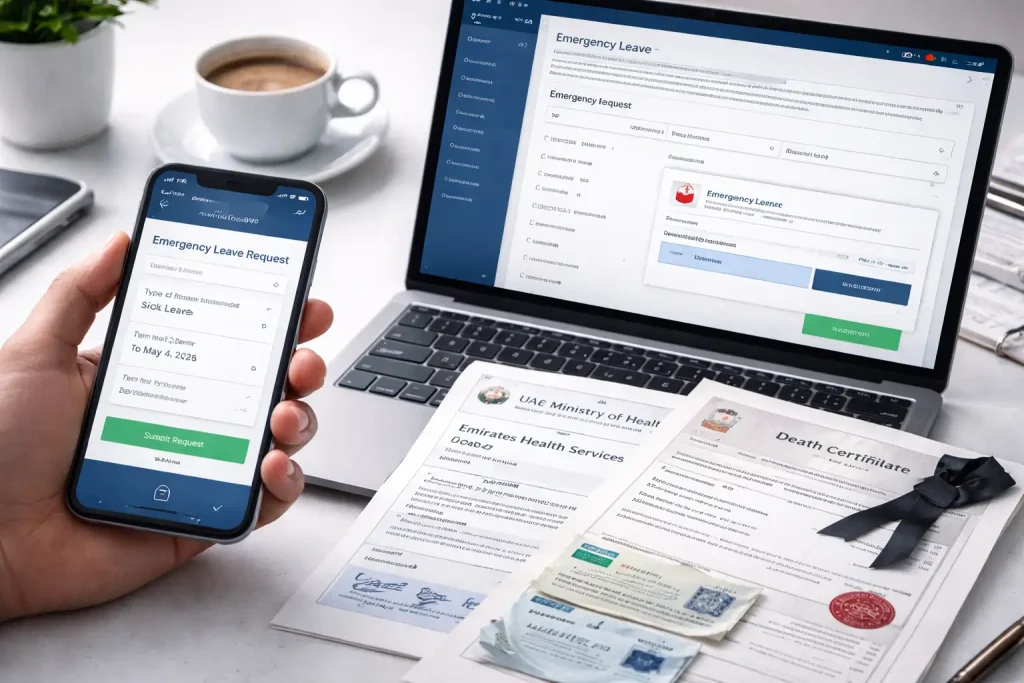
Digital Requests: MoHRE App and HR Portals
Most modern companies in the UAE now use HR software integrated with MoHRE systems. When an emergency happens, your first step is to send a quick message to your manager, but your second step must be to log it in the system. If you have a dispute later, MoHRE will review the timestamp on your leave request.
Proving Your Absence: Medical vs. Death Certificates
You cannot just claim an emergency and expect no questions. For medical issues, a certificate from a UAE-registered clinic (linked to the Malaffi or Nabidh systems) is best. For overseas emergencies, you may need to get documents attested by the UAE Embassy in that country, though many companies in 2026 accept digital copies for initial approval.
Resolving Disputes: The AED 50,000 Fast-Track
This is perhaps the most important “gap” we found in competitor content. The way we solve problems in 2026 is much faster.
Bypassing Courts for Small Salary Claims
In the past, if your boss wrongly deducted AED 2,000 from your salary for “emergency leave,” you had to go to the Labor Court. You had to wait months to get here. But now, under the new 50,000 AED Rule, MoHRE acts as the judge. If your claim is small (under 50k), they look at the evidence and make a final call. This decision is final and binding. It means the police or a bank can step in right away to enforce it.
The 14-day Mediation Window at MoHRE Centers
When you file a complaint about a leave dispute, MoHRE will try to settle it amicably within 14 days. If the employer doesn’t agree to pay what is owed, and the amount is under AED 50,000, the Ministry makes the final call. It has made the workplace much fairer for employees with small but important grievances.
Best Practices for 2026 Employers
If you are running a business in the UAE, managing emergency leave is about more than just being “nice”; it’s about avoiding legal trouble.
Updating “Force Majeure” Clauses in Employment Contracts
Does your contract mention what happens during a sandstorm or a flood? In 2026, it should. Employers should update their contracts to define when “Remote Work” is the default so that they don’t have to scramble with “Emergency Leave” requests every time the weather turns.
Managing the Nafis Salary Support Interaction During Leave
For HR managers, the priority is ensuring that WPS (Wage Protection System) files match the actual days worked. If an Emirati employee is on unpaid leave, you must use the correct “Reason Code” in the WPS file. Failure to do so can result in the employee losing their Nafis top-up for that month, a quick way to lose a talented local team member.
Common Misunderstandings & Myths
Let’s clear up some of the most common “water cooler” myths that we see in 2026.
- Myth 1: “Emergency leave is a 100% legal right.”
Truth: Not exactly. While you have a right to be treated fairly, “Emergency Leave” as a specific paid category doesn’t exist. It is usually taken out of your annual leave or taken unpaid.
- Myth 2: “My boss can’t say no to a family emergency.”
Truth: They can say no if there is a critical “operational need.” However, in 2026, the employer must prove that your absence would cause significant harm to the business. If they say no without a good reason, you can report it to MoHRE.
- Myth 3: “I don’t need proof if it’s an emergency.”
Truth: You almost always need proof. Whether it’s a doctor’s note, a police report for an accident, or a flight ticket, documentation is your best friend if the case goes to mediation.
Conclusion
The UAE workplace in 2026 is all about balance. With the new Savings Scheme and the fast MoHRE dispute system, both workers and bosses have better protection than ever. Being an employer means staying transparent to avoid big fines. With the right apps and a handle on the 2026 rules, you can get through any sudden life crisis without losing your peace of mind.
Frequently Asked Questions
Can my employer reject my emergency leave request?
If your time off would cause big problems at work, your boss can say no. But they still have to be fair and not say no without a good reason.
Is emergency leave mandatory under UAE Labour Law?
There is no specific “emergency” article, but it is managed through your annual leave, sick leave, or unpaid time off.
Do I need proof for emergency leave?
It’s a good idea to provide a medical note, death certificate, or school alert. It helps protect your job and ensures your pay is secure during a tough time
How many days of emergency leave can I take?
The law does not set a fixed number of days, so it depends on your company policy and your available leave balance.


