
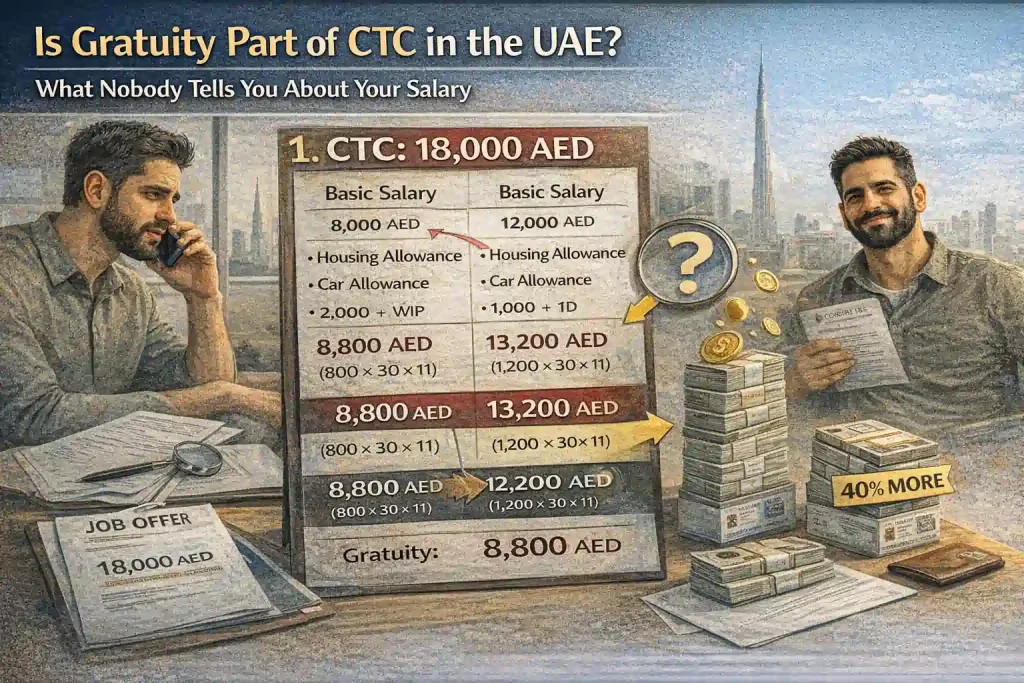
Is Gratuity Part of CTC in the UAE? What Nobody Tells You About Your Salary
Last month, a cousin called from Dubai. Fresh graduate. First proper job offer.
“They’re offering 18,000 a month. Is that good?”
One question changed everything: “What’s your basic salary?”
Silence.
Then: “What do you mean by basic? It’s 18,000. That’s the number, right?”
He’d done what most people do. Saw the big number. Got excited. Almost signed.
A quick breakdown changed his mind. Showed him how two people with the same 18,000 can end up with completely different amounts of money in the long run.
He called them back. Asked the right questions. They adjusted the structure. His future gratuity went up by nearly 40%.
Same CTC. More money when it mattered.
That conversation stuck. Because most people never have it. They sign. They hope. Years later, they wonder why their gratuity was smaller than expected.
This guide is that conversation. For you
Let’s Start at the Very Beginning: What Even Is CTC?
That first offer letter arrives. Big number at the bottom. CTC: 20,000 AED. The brain does a quick calculation: “20,000 a month. That’s what I’ll get.”
Makes sense. Until it doesn’t.
CTC stands for Cost to Company. It’s the total amount your employer spends on you in a year. Not what lands in your bank account every month. What they spend.
Think of it like buying a car. The sticker price is one thing. But by the time you add insurance, registration, servicing, and fuel, the real cost looks completely different.
A salary works the same way.
What’s Actually Inside Your CTC
| Component | What It Really Is | Do You See It Monthly? |
| Basic Salary | The foundation of everything | Yes |
| Housing Allowance | Money for rent | Yes |
| Transport Allowance | Getting to work | Yes |
| Food Allowance | Sometimes included | Yes |
| Education Allowance | For kids’ school fees | Usually paid directly |
| Flight Tickets | Annual trip home | Once a year |
| Medical Insurance | Health coverage | Paid by employer |
| Visa Costs | Your residency | Paid by employer |
| Gratuity Provision | Your future money | When you leave |
| Bonus/Commission | Performance-based | Sometimes |
The Part That Trips Everyone Up
When your offer letter says “CTC: 20,000 AED per month,” here’s what that actually means:
Your employer has calculated that keeping you on the payroll costs them 20,000 every month. But you won’t see all of that.
Some of it goes to things you’ll never touch, like visa fees and insurance. Some of it gets set aside for later, like your flight ticket and gratuity. The rest lands in your account.
The trick is knowing which is which.
The Million Dirham Question: Is Gratuity Actually Part of CTC?

Short answer: Yes. But it’s not what you think.
Long answer: Grab a coffee. This matters.
How Employers See Gratuity
When an employer offers you a salary, they do math. Lots of it.
Here’s what runs through their head:
“If I pay this person 12,000 in cash every month, I also need to budget for their insurance, visa, annual flight, and the gratuity I’ll owe them when they leave.”
So they add it all up. Divide by 12. And that becomes your CTC.
| Component | Monthly Cost to Employer |
| Your monthly cash salary | 10,000 |
| Medical insurance | 400 |
| Visa processing (amortized) | 200 |
| Annual flight ticket (amortized) | 300 |
| Gratuity provision (amortized) | 500 |
| Total Monthly CTC | 11,400 |
See that last line? 500 AED every month is set aside for your future gratuity.
That’s why gratuity is “part” of your CTC. Your employer budgets for it from day one.
But Here’s What You Never See
That 500 AED doesn’t sit in an account with your name on it. It doesn’t earn interest. It’s just a number on a spreadsheet.
You only get it if:
- You have completed at least one year
- You leave for reasons that entitle you to gratuity
- The amount is calculated based on your basic salary, not your CTC
This last part catches everyone.
Why This Confusion Has Cost People Thousands
Let’s talk about two friends. Same industry. Same experience. Both got job offers around the same time.
Friend A: The Big Number Hunter
Offer: 22,000 CTC
Monthly cash: 20,000
Basic salary: 7,000 (about 35% of CTC)
He thought: “22,000! That’s huge. Sign me up.”
Friend B: The One Who Asked Questions
Offer: 20,000 CTC
Monthly cash: 17,000
Basic salary: 10,000 (about 50% of CTC)
She thought: “Less monthly cash. But let me check the math.”
What Happened Three Years Later
Both worked hard. Both got promoted. Both decided to switch companies around the same time.
Time to calculate gratuity.
| Factor | Friend A | Friend B |
| Basic salary | 7,000 | 10,000 |
| Years worked | 3 | 3 |
| Contract type | Limited | Limited |
| Gratuity calculation | 7,000 ÷ 30 × 21 × 3 | 10,000 ÷ 30 × 21 × 3 |
| Gratuity amount | 14,700 AED | 21,000 AED |
Difference: 6,300 AED.
That’s not pocket change. That’s a new laptop. A holiday. Three months of groceries.
But Wait. There’s More.
Friend A earned 3,000 more per month for three years. That’s 108,000 AED extra in his pocket over three years.
Friend B earned less monthly but walked away with 6,300 more at the end.
| Over 3 Years | Friend A | Friend B |
| Total monthly cash | 720,000 | 612,000 |
| Gratuity | 14,700 | 21,000 |
| Total | 734,700 | 633,000 |
Friend A still came out ahead by about 100,000 AED over three years.
So was Friend B wrong?
No. Because here’s what the numbers don’t show:
Friend A spent most of his higher monthly cash. Better car. Fancier dinners. Bigger apartment.
Friend B saved aggressively, knowing her monthly income was lower.
When they both look at their bank balances after three years? Friend B had more saved.
The higher basic didn’t just mean higher gratuity. It meant she was forced to live on less. And that discipline paid off.
The Three Numbers You Need to Know (And Never Confuse Again)
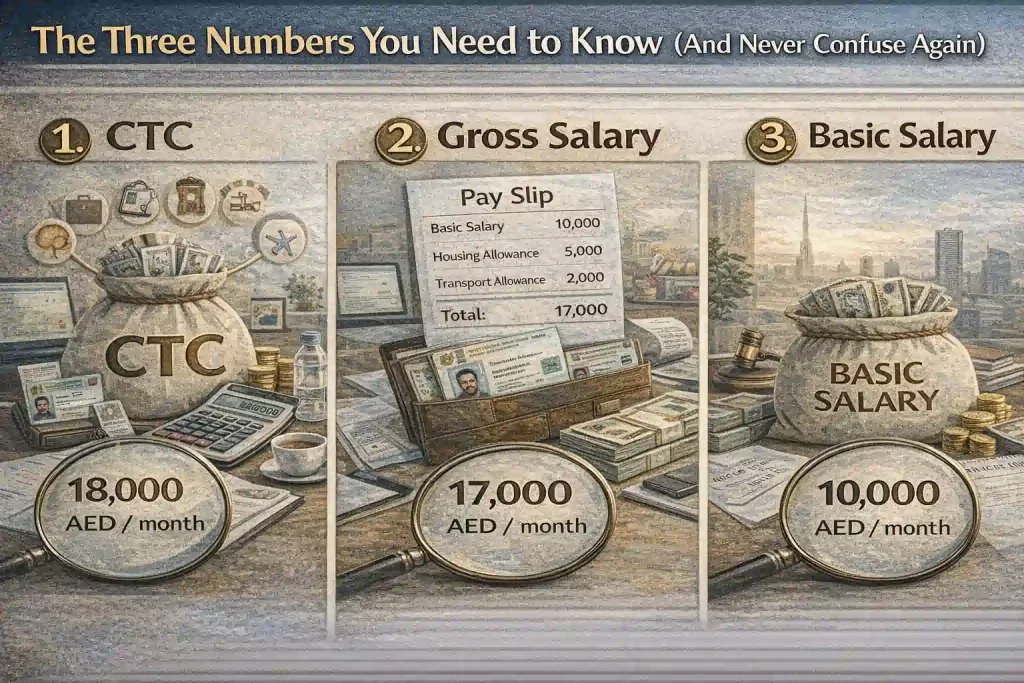
Most people think a salary is one number. It’s not. It’s three.
Number 1: CTC (Cost to Company)
What it is: Total annual cost to your employer divided by 12.
What it includes: Your cash salary + all benefits + gratuity provision.
What it’s good for: Comparing job offers at a high level. Negotiating your worth.
What it’s NOT: Your monthly income.
Number 2: Gross Salary
What it is: Your monthly cash income before any deductions.
What it includes: Basic salary + housing allowance + transport + other allowances.
What it’s good for: Budgeting your monthly life. Rent. Car payments. Groceries.
What it’s NOT: Your take-home pay (if you have deductions like loans or a pension).
Number 3: Basic Salary
What it is: The foundation amount. Usually 40-60% of gross.
What it includes: Just the base. No allowances.
What it’s good for: Calculating gratuity, overtime, and sometimes loan eligibility.
What it’s NOT: You’re spending money.
How They Connect
Picture a Russian doll.
The smallest doll is Basic Salary. It sits inside the middle doll, which is Gross Salary. And both sit inside the biggest doll, which is CTC.
| Level | Contains | Used For |
| CTC (biggest) | Gross + benefits | Employer budgeting |
| Gross (middle) | Basic + allowances | Monthly cash flow |
| Basic (smallest) | Foundation amount | Gratuity calculation |
Why This Matters Right Now
If you’re reading this and thinking, “I have no idea what my basic is,” stop. Find your contract. Look it up.
That one number determines thousands of dirhams in your future.
How UAE Companies Actually Structure Salaries (The Unwritten Rules)
After a decade in the UAE and conversations with dozens of HR people, here’s what I’ve learned about how salaries really work.
The 50-30-20 Rule (Unofficial)
Most companies follow a loose pattern:
| Component | Typical Range | Why |
| Basic Salary | 50-60% of gross | Legal minimums, gratuity calculation |
| Housing Allowance | 20-30% of gross | Market standard, rent coverage |
| Transport Allowance | 5-10% of gross | Commute costs |
| Other Allowances | 5-15% of gross | Flexibility for negotiation |
Why Companies Structure This Way
Reason 1: Legal Requirements
UAE labour law requires certain allowances to be specified. Housing, transport, and food are common.
Reason 2: Gratuity Control
Higher basic means higher future liability for the company. Some employers keep basic costs low to reduce their long-term costs.
Reason 3: Negotiation Flexibility
Allowances are easier to adjust than basic. Want more monthly cash? They bump up transport. Want higher gratuity? They adjust basic.
Reason 4: Industry Norms
Banks do it one way. Construction does it another way. Free zones have their own rules.
Industry Breakdown (From Real Offers I’ve Seen)
| Industry | Typical Basic % | Typical Housing % | Notes |
| Banking/Finance | 60-70% | 20-25% | High basic, performance bonuses |
| Construction | 40-50% | 25-35% | Site allowances common |
| Retail | 50-55% | 20-25% | Staff discounts instead of cash |
| Healthcare | 55-65% | 20-25% | Professional registration matters |
| Education | 50-55% | Often provided directly | Accommodation sometimes in-kind |
| Tech Startups | 50-70% | 15-25% | Wide variation, equity possible |
| Government | 60-70% | 20-25% | Pension contributions |
What This Means for You
If you’re in banking, your basic will likely be higher. Good for gratuity.
If you’re in construction, your basic might be lower. Your monthly cash might look good, but your end-of-service will suffer.
Neither is wrong. But you need to know which game you’re playing.
The Real Math, How Your CTC Becomes Your Gratuity
Let’s get practical. Here’s exactly how to calculate what you’ll actually get.
Step 1: Find Your Basic Salary
Look at your contract. Find the line that says “Basic Salary.”
If it’s not clearly stated, email HR: “Could you confirm my basic salary as shown in the contract?”
Step 2: Know Your Contract Type
| Contract | Gratuity Rules |
| Limited | Full 21 days/year (first 5 years), then 30 days/year |
| Unlimited | Reduced rates first 5 years |
Contract type affects everything; understand the difference between limited and unlimited before you sign.
Step 3: Do the Math
Formula: (Basic ÷ 30) × 21 × Years = Annual Gratuity
Example:
Basic: 8,000 AED
8,000 ÷ 30 = 266.67 (daily rate)
266.67 × 21 = 5,600 AED (one year’s gratuity)
5,600 × 3 years = 16,800 AED
Step 4: Adjust for Contract Type
If you’re on unlimited, it’s not that simple.
| Years | Unlimited Rate |
| 1-3 years | 1/3 of 21 days/year |
| 3-5 years | 2/3 of 21 days/year |
| 5+ years | Full 21 days/year |
Same 8,000 basic, unlimited contract, 4 years:
Year 1-3: 5,600 ÷ 3 = 1,867 × 3 = 5,600
Year 4: 5,600 × ⅔ = 3,733
Total: 9,333 AED
Compared to the limited: 16,800 AED. Difference: 7,467 AED.
Step 5: Connect It Back to CTC
Your CTC determined your basic. Your basic determined your gratuity.
| Scenario | CTC | Basic % | Basic | Gratuity (3 yrs, limited) |
| Offer X | 20,000 | 40% | 8,000 | 16,800 |
| Offer Y | 18,000 | 60% | 10,800 | 22,680 |
Calculate your exact gratuity based on your basic salary with our calculator.
Offer Y has lower CTC but higher gratuity.
This is why you need to look beyond the big number.
See how your basic salary translates to actual gratuity when you’re ready to apply.
What to Actually Do When You Get a Job Offer
You’ve got the offer. Congratulations. Now don’t mess it up.
Step 1: Don’t Say Yes Immediately
Even if it’s your dream job. Even if the number looks amazing.
Say: “Thank you so much. Let me review the details and get back to you tomorrow.”
You’ll need an e-signature card to sign that new contract. Here’s how to get it.
Step 2: Break Down the Numbers
Create a simple table:
| Component | Amount |
| Basic Salary | ? |
| Housing Allowance | ? |
| Transport Allowance | ? |
| Other Allowances | ? |
| Gross Monthly | ? |
| Insurance (if deducted) | ? |
| Net Monthly (approx) | ? |
If anything is missing, ask.
Step 3: Calculate Your Future Gratuity
Use the formula discussed above.
| Years You Might Stay | Estimated Gratuity |
| 2 years | ? |
| 3 years | ? |
| 5 years | ? |
Step 4: Compare With Other Offers
Don’t compare CTC to CTC. Compare:
- Monthly cash (what you live on)
- Basic salary (what your future depends on)
- Total package over expected tenure
Step 5: Negotiate (Yes, You Can)
Here’s what’s negotiable:
| Component | Negotiable? | How |
| Basic salary | Yes | “Could we increase the basic component?” |
| Housing allowance | Yes | “Market rate for my role is usually higher.” |
| Transport | Yes | “My commute will cost approximately…” |
| Other benefits | Yes | “Is there flexibility on flights/insurance?” |
| CTC total | Yes | “I was hoping for something closer to…” |
What to Actually Say
“I’m really excited about the role. Reviewing the structure, I noticed the basic is on the lower side. Since gratuity is calculated on basic, would it be possible to adjust the split, say, increase basic by 10% and adjust allowances accordingly?”
The worst they can say is no.
Real Questions People Have Asked Me
Over the years, friends, cousins, and strangers have asked me versions of these questions. Here are the ones that come up most.
“My offer letter doesn’t show basic salary. Is that normal?”
Not really. It should. Ask HR for the breakdown. If they won’t provide it, that’s a red flag.
“Can my employer change my basic later?”
Only with your agreement. If they try, question it. Especially if it affects your gratuity.
“I’ve been here 5 years. Should I ask for a restructure?”
You can. Frame it as: “I’m planning to stay long-term. Would it be possible to review my salary structure to better align with my future here?”
“Does higher basic mean I pay more for anything?”
In the UAE, no income tax. So a higher basic doesn’t cost you monthly. It only helps your gratuity.
“What if my company says basic is fixed by law?”
They’re bending the truth. There’s a minimum basic, but no maximum. Push back gently.
“I’m moving from India. Should I think about this differently?”
Yes. In India, a higher basic can mean higher tax. In the UAE, no tax. So prioritize basic here more than you would back home.
“My friend has the same CTC as me but a higher basic. Can I complain?”
You can ask for a review. But companies often structure differently based on negotiation. Use it as info for your next conversation.
Industry Secrets HR Won’t Tell You
After years of conversations with people on both sides of the table, here’s what I’ve learned.
Secret 1: They Expect You to Negotiate
HR professionals don’t get offended when you ask questions. They get impressed. It shows you’re paying attention.
The ones who sign without reading? They worry about those people later.
Secret 2: Basic Is Often the Hardest to Move
Companies have payroll systems. Changing basic might require approvals. Allowances are easier to adjust.
So if they can’t move basics, ask for higher allowances instead. Then save the difference.
Secret 3: They’ve Done This Math Before
When they offered you that CTC, they knew exactly how it breaks down. They know what your basic is. They know what your gratuity will be.
If you don’t ask, they assume you don’t care.
Secret 4: Different Departments Have Different Budgets
Sometimes the person hiring you wants to give you more, but their budget is fixed. Ask if other departments (like training or wellness) have funds that could be reallocated.
Sounds strange. Works more often than you’d think.
Secret 5: The Best Time to Negotiate Is Before You Sign
Once you’ve signed, your leverage drops. Before you sign, they want you. After you sign, they have you.
Use that window.
If You’re Already Working (It’s Not Too Late)
Maybe you’re reading this and thinking: “Great. I already signed. Two years ago. Now what?”
You still have options.
Option 1: Ask for a Review
Annual review time is perfect.
“I’ve been here two years and really value this role. Looking ahead, I’m thinking about my long-term future with the company. Would it be possible to review my salary structure, specifically the basic component?”
Option 2: Use a Promotion
Promotions often come with new contracts. That’s your moment.
“Thank you for the promotion. As we update my contract, could we also look at the basic/allowance split?”
Option 3: Consider Your Next Move
Even if this job doesn’t change, now you know for the next one.
Every interview is a chance to apply what you’ve learned.
Option 4: Adjust Your Savings
If your basic is lower than you’d like, compensate by saving more.
| If Your Basic Is | Your Gratuity Will Be Lower by | Save Extra Monthly to Compensate |
| 30% of CTC | About 40% less | 5-10% of monthly salary |
| 40% of CTC | About 20% less | 2-5% of monthly salary |
| 50%+ of CTC | On track | Keep going |
Common Traps People Fall Into
Trap 1: Chasing the Biggest Number
The biggest CTC doesn’t always mean the best package. Look at the structure.
Trap 2: Ignoring the Contract
If it’s not in writing, it doesn’t exist. Verbal promises about future adjustments? Get them in the contract or email.
Trap 3: Assuming All Companies Are the Same
They’re not. Some deliberately keep basic low. Some structure fairly. Know which is which.
Trap 4: Waiting Too Long to Ask
Ask before you sign. After signing, your leverage is gone.
Trap 5: Forgetting About Gratuity Entirely
Most people think about gratuity when they’re leaving. By then, it’s too late to change.
Think about it when you join.
Quick Reference, What to Remember
The Three Numbers
| Number | What It Is | Why It Matters |
| CTC | Total employer cost | Comparing offers |
| Gross | Monthly cash | Your budget |
| Basic | Foundation | Your gratuity |
The Gratuity Formula
(Basic ÷ 30) × 21 × Years = Annual Gratuity (limited contract)
The Questions to Ask
- “What’s my basic salary?”
- “What percentage of CTC is basic?”
- “Can we adjust the split?”
- “Is gratuity calculated on basic?”
- “Can I see a full breakdown?”
The Red Flags
- No basics mentioned
- Basic under 40% of CTC
- Reluctance to share breakdown
- “It’s standard” without explanation
- Pressure to sign immediately
Your Next Move
You made it. Seriously, this was a lot. But now you know what most people never learn.
What to Do This Week
| Your Situation | One Thing |
| Reviewing an offer | Ask for a basic breakdown |
| Currently employed | Check your contract |
| Planning to switch | Use this in interviews |
| Near leaving | Calculate your gratuity |
| Just confused | Read Section 2 again |
The 5-Minute Action Plan
Minute 1: Find your contract
Minute 2: Identify your basic salary
Minute 3: Calculate basic as % of gross
Minute 4: Estimate future gratuity
Minute 5: Decide if you need to act
One Last Thing
Remember my cousin from the beginning? The one with the 18,000 offer?
He starts next week. Basic: 9,500. Housing: 5,500. Transport: 1,500. Other: 1,500.
He asked. They adjusted. His future gratuity went up by thousands.
All because he asked.
Your turn.


