
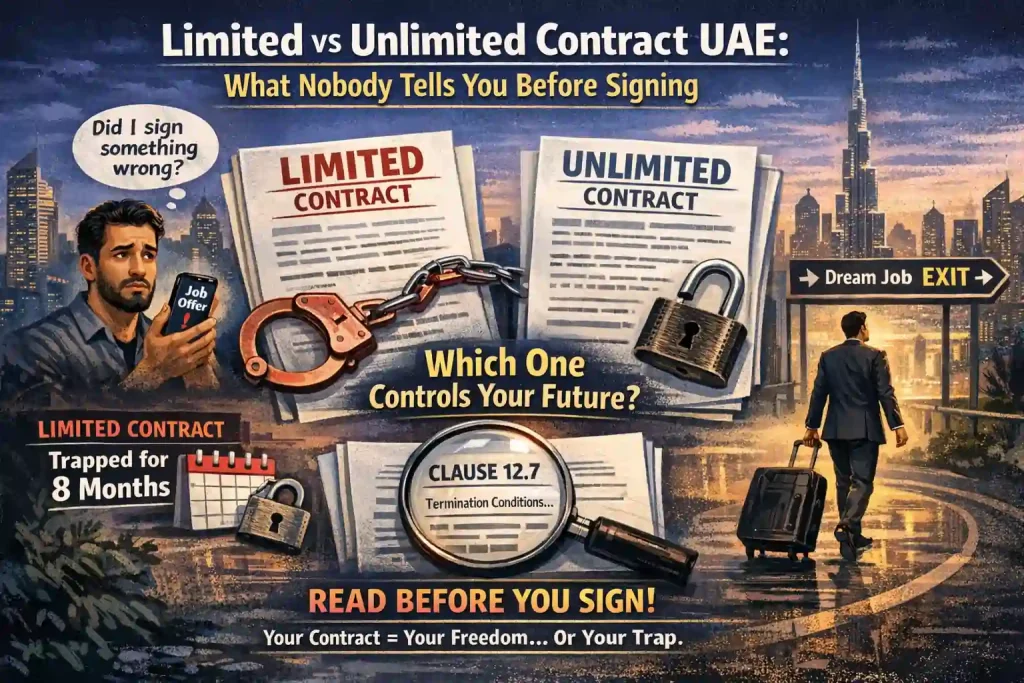
Limited vs Unlimited Contract UAE: What Nobody Tells You Before Signing
Last Thursday, 11:37 PM. A phone buzzes.
Karim has a problem. New job offer. The current employer is blocking his exit. “Did I sign something wrong?”
One question: “Limited or unlimited contract?”
His answer: “Honestly? I just signed whatever they put in front of me.”
This conversation happens daily.
Someone gets a great opportunity. Then realizes: the contract they signed 18 months ago controls when they can leave. Not their performance. Not their boss. A piece of paper they probably signed on their phone without reading clause 12.7.
Karim got lucky. The guy before him? Limited contract. Eight months left. His dream job vanished.
That’s what this guide prevents.
Here’s the thing: You’re reading this now. Before something goes wrong. That’s 90% of the battle.
By the end, you’ll know exactly what these contracts actually do to your life not textbook definitions. Which one protects you? And one question to ask before signing anything ever again.
Let’s go.
Limited Contracts: What Most People Get Wrong
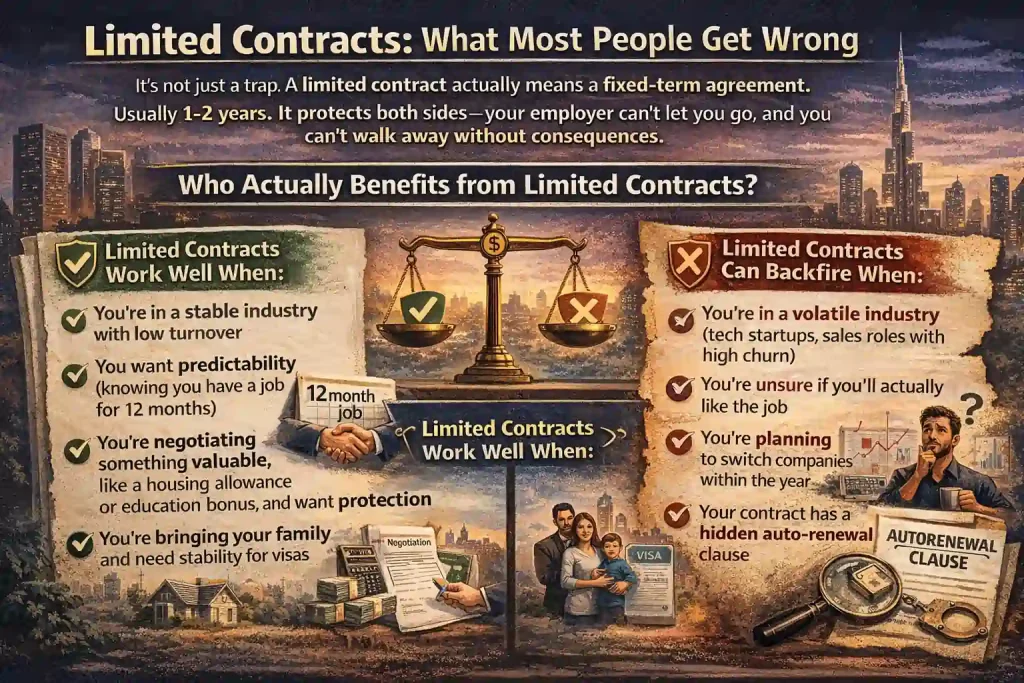
When most people hear “limited contract,” they think: I’m trapped.
Makes sense. The word “limited” sounds restrictive. Like you’re locked in. Like you’ve signed away your freedom.
That’s not the full picture.
Here’s what a limited contract actually means: a fixed-term agreement. Usually one year. Sometimes two. It has a start date. An end date. And yes, both sides generally commit until that end date arrives.
But here’s what nobody tells you: That commitment runs both ways.
Your employer can’t let you go without compensation. You can’t just walk away without consequences. It’s a mutual agreement. A trade. Stability for both sides.
Who Actually Benefits From Limited Contracts?
The honest answer: It depends on your situation.
Limited contracts work well when:
- You’re in a stable industry with low turnover
- You want predictability (knowing you have a job for 12 months)
- You’re negotiating something valuable like a housing allowance or education bonus, and want protection
- You’re bringing your family and need stability for visas
Limited contracts can backfire when:
- You’re in a volatile industry (tech startups, sales roles with high churn)
- You’re unsure if you’ll actually like the job
- You’re planning to switch companies within the year
- Your contract has a hidden auto-renewal clause (more on this in a minute)
The Fine Print Nobody Reads
Here’s what makes limited contracts tricky: Article 8 of the UAE Labour Law.
In plain English? If you leave a limited contract early, before those 12 months are up, your employer can claim compensation. Usually, 45 days’ salary or the remaining salary until the contract ends. Whatever is less.
But here’s the part employers don’t advertise: They have to prove actual damages. They can’t just charge you for leaving. You have rights, too.
One real example:
A marketing manager signed a two-year limited contract. Eight months in, she got a dream role at a competitor. Her employer demanded 45 days’ salary to release her. She asked them to prove their damages. They couldn’t. She paid nothing. Walked free in 30 days.
The law exists to protect you. Most people just don’t know how to use it.
The Auto-Renewal Trap
Watch for this.
Some limited contracts include a clause that says: “This contract shall automatically renew for a similar period unless either party gives 30 days’ notice.”
Sounds harmless. Until you forget. Until you’re 11 months in, planning to leave, and realize you’re already locked in for another year.
Read this clause. Cross it out if needed. Everything is negotiable before you sign.
Unlimited Contracts: What They Don’t Advertise
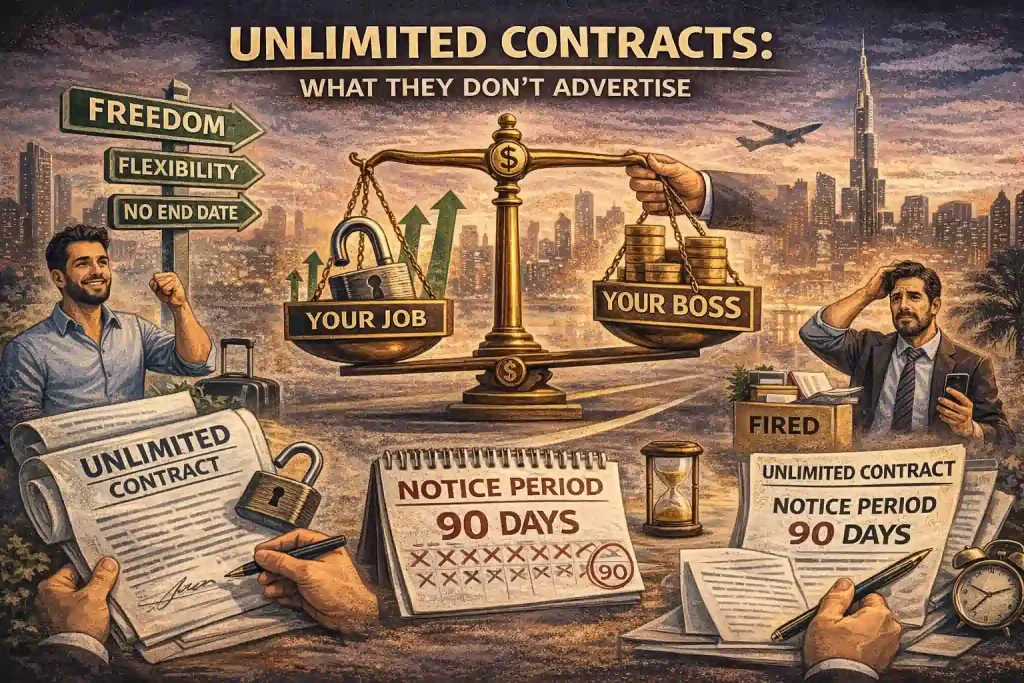
Ask most people about unlimited contracts, and they’ll say: “More freedom. Less commitment. Safer if I want to switch jobs.”
Makes sense. The word “unlimited” sounds open. Flexible. Like you’re in control.
Here’s what catches people off guard:
That flexibility? It cuts both ways.
An unlimited contract has no end date. You’re employed indefinitely. Sounds great until your employer decides they want you gone. Or until you want to leave and realize the notice period you agreed to is longer than you remembered.
Let’s break down what unlimited contracts actually mean, not the HR pitch, but the reality.
What Unlimited Contracts Actually Do
The simple version:
You work. You get paid. Every month rolls into the next. No fixed end date. Either side can end the relationship by giving notice.
The version nobody tells you:
That notice period? You agreed to it. It’s in your contract. And if it’s 90 days? You’re stuck for three months while your new job waits. Or doesn’t.
True story:
A friend in Dubai signed an unlimited contract. Great salary. Great title. Scanned page 6. Ninety days’ notice. Thought: “I’ll never need to leave.”
Eighteen months later, a dream job in Abu Dhabi. Start date: four weeks away. His current employer? “Contract says 90 days. You’re staying.”
He asked to negotiate. They said no. He offered to pay. They said no. The Abu Dhabi job vanished.
His words afterward: “I thought unlimited meant I could leave whenever I wanted. Nobody explained the fine print.”
The Notice Period Trap
This is where unlimited contracts get dangerous.
Here’s what happens:
- You sign. Notice period seems irrelevant.
- Life changes. Better offer arrives.
- You give notice. Employer says: “Actually, we need you for the full 90 days.”
- New employer says: “We can’t wait that long.”
- Opportunity gone.
The hard truth: Notice periods in unlimited contracts are enforceable. You agreed to them. They’re not suggestions.
But here’s what protects you:
| Your Right | What It Means |
| You can negotiate | Before signing, ask: “Can we make it 30 days?” |
| You can pay in lieu | Some employers accept payment instead of service |
| You can take unused leave | Use accrued vacation days to reduce notice |
| You can ask for early release | Employers sometimes say yes—especially if you’re replaceable |
One thing that works: “I’ll train my replacement for two weeks and document everything.” Smart employers take this deal.
Who Unlimited Contracts Actually Benefit
Unlimited contracts work well when:
- You’re in a fast-moving industry (tech, media, startups)
- You’re early in your career and want mobility
- You’re testing a new role or company
- Your notice period is reasonable (30 days or less)
Unlimited contracts can hurt when:
- Your notice period is 60–90 days
- Your industry has slow hiring cycles
- You’re in high demand (employers will fight to keep you)
- You didn’t read the termination clauses
The Employer’s Secret Advantage
Here’s what employers know that most employees don’t:
With unlimited contracts, they can terminate you with notice, too, and they don’t need a reason. No performance issue required. No misconduct. Just notice and payment.
Example:
A company restructures. They decide your role is redundant. Unlimited contract? They give you 30 days’ notice (or pay in lieu), and you’re done. Limited contract? They’d owe you compensation for the remaining term.
This isn’t meant to scare you. Just to show: unlimited cuts both ways. You can leave. They can let you go. Everyone has options.
The “Gratuity Impact” Nobody Discusses
Your end-of-service benefit changes based on contract type.
For unlimited contracts:
- Less than 1 year: No gratuity
- 1–3 years: 1/3 of 21 days’ salary per year
- 3–5 years: 2/3 of 21 days’ salary per year
- 5+ years: Full 21-day salary per year
Compared to limited contracts:
- 1–3 years: Full 21-day salary per year
- 3–5 years: Full 21-day salary per year
- 5+ years: Full 30 days’ salary per year
Translation: For the first five years, limited contracts pay more gratuity. Same work. Same salary. Different contract. Different payout.
Worth understanding before you sign.
Three Clauses To Find Before Signing
Grab your contract. Look for these:
| Clause | Why It Matters |
| Notice Period | 30 days is standard. 60+ is a trap. |
| Garden Leave | Can they make you stay home but not work elsewhere? |
| Non-Compete | Can you join a competitor after leaving? |
If any of these feel aggressive? Question them. Mark them up. Send them back. The worst they can say is no.
And here’s a secret: Most employers expect you to negotiate. The ones who don’t? Probably not places you want to work anyway.
When Unlimited Makes Sense (And When It Doesn’t)
| Situation | Contract Choice |
| You want stability for 2+ years | Limited |
| You’re testing a new industry | Unlimited |
| You have a family visa to protect | Limited |
| You want job-hopping freedom | Unlimited (with short notice) |
| You’re negotiating high severance | Limited |
| You’re in a volatile market | Unlimited |
No single right answer. Just what fits your life right now.
One Last Thought
Unlimited contracts aren’t bad. They’re just misunderstood.
The problem isn’t the contract type. It’s signing without knowing:
- What notice period did you agree to
- How gratuity changes
- What happens if they let you go
- Whether you can negotiate
Read it. Question it. Own it.
Because the person who loses from a bad contract isn’t the employer. It’s the person who signed without asking.
Article 8: The Law Everyone Cites But Nobody Explains
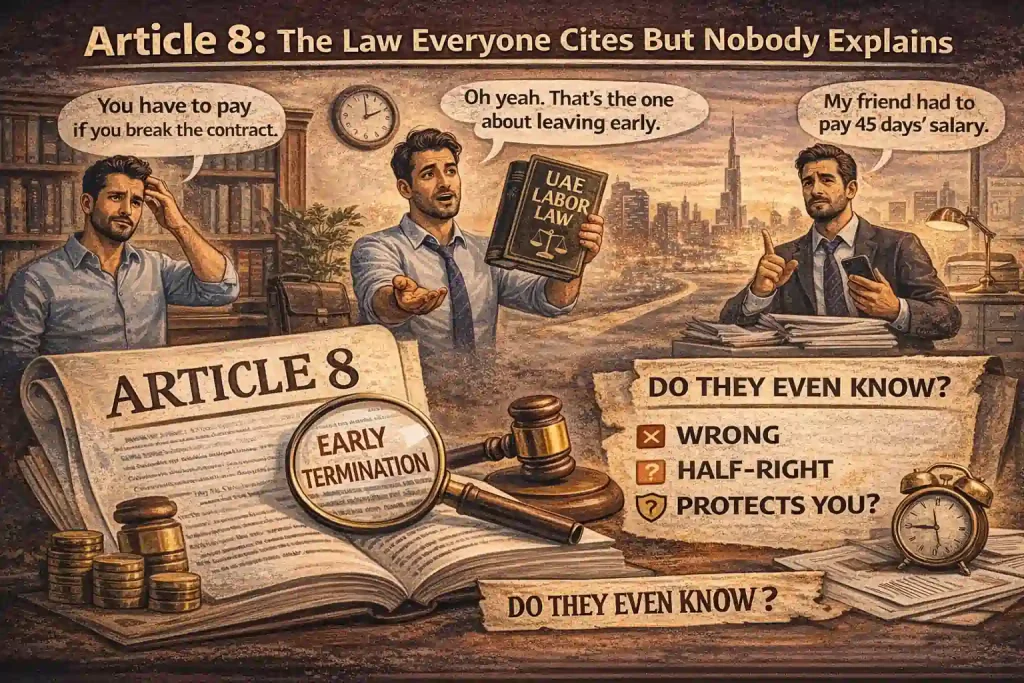
Walk into any UAE office and ask about Article 8.
You’ll get:
“Oh yeah. That’s the one about leaving early.”
“You have to pay if you break contract.”
“My friend had to pay 45 days salary.”
Here’s what nobody actually tells you: Most of what people “know” about Article 8 is wrong. Or half-right. Or right but missing the part that protects you.
Let’s fix that.
What Article 8 Actually Says
The simple version:
If you leave a limited contract early, your employer can claim compensation.
The version the law actually wrote:
Article 8 of Federal Law No. 8 (and its updates) says employers can claim “losses” if an employee leaves before the contract ends. But here’s the part everyone skips: They have to
prove those losses.
Not just claim them. Prove them.
The Myth vs. The Truth
| What People Believe | What’s Actually True |
| “I automatically owe 45 days salary” | You owe nothing unless they prove damages |
| “My employer can block my new job” | They can’t. MOHRE handles releases. |
| “I’m trapped until I pay” | You can file a complaint and keep working |
| “Article 8 applies to all contracts” | Only limited contracts. Unlimited is different. |
Meet Ahmed
Ahmed worked for a logistics company in Dubai. Limited contract. Eighteen months left.
A better offer came. He gave notice. His employer said: “Pay us 45 days salary or we don’t release you.”
Ahmed panicked. Almost paid 12,000 AED he didn’t have.
Then someone told him, “Ask them to prove damages.”
He did.
Silence.
Then: “We’ll release you with 30 days’ notice.”
No payment. No fight. Just a question his employer couldn’t answer.
Moral: Most employers bluff. Call it.
When Employers Actually Win
Here’s the truth: Some employers can prove damages.
Real examples where Article 8 claims succeed:
- A sales manager left mid-quarter. Lost a major deal she was leading. The company proved to have lost revenue.
- An engineer left during a critical project. Replacement cost 25,000 AED to hire urgently. The company proved the cost.
- A teacher left mid-term. The school hired a substitute at a higher rate. Proved the difference.
The pattern: Specific, measurable, documented losses.
What doesn’t count: “We’re upset you left.” “We have to hire someone.” “It’s inconvenient.”
Vague feelings? No damages. Real costs? Different story.
Your Rights Under Article 8
Here’s what the law actually gives you:
| Right | What It Means |
| Right to proof | They show receipts. You don’t just pay. |
| Right to complain | MOHRE hears both sides. Free filing. |
| Right to work | You keep working during disputes. |
| Right to a new job | No one blocks your MOHRE card forever. |
| Right to appeal | The Labour Court exists for bad decisions. |
One sentence to remember:
“Please provide documentation of actual damages incurred.”
Say it. Email it. Watch how often the demand disappears.
The 45 Day’s Confusion
Where does “45 days” even come from?
Article 8 mentions 45 days as a cap. Maximum possible claim. Not automatic. Not standard. Not the first offer.
Think of it like a speed limit. Just because it says 120 doesn’t mean you drive 120 everywhere. Conditions matter.
Same with Article 8. Just because 45 days is the max doesn’t mean you owe it. Conditions matter. Proof matters. Context matters.
Limited vs. Unlimited Under Article 8
Limited contracts:
- Article 8 applies
- The employer can claim damages
- You can request proof
- Maximum claim: 45 days or remaining term (whichever is less)
Unlimited contracts:
- Article 8 doesn’t apply the same way
- Notice period is your main obligation
- No “damages” for leaving
- You just work notice or pay in lieu
This is why contract type matters. Unlimited? Walk with notice. Limited? More steps. More rights. More employer leverage.
What To Do If You’re In This Situation
Scenario 1: You haven’t resigned yet
- Check your notice period
- Calculate the remaining contract term
- Ask: “Can they prove damages if I leave?”
- Consider timing (end of project? slow season?)
Scenario 2: You already resigned, employer demands payment
- Don’t pay immediately
- Ask for a written damage breakdown
- Contact MOHHE (free, fast, online)
- Keep showing up to work
Scenario 3: Employer refuses to cancel your card
- File MOHRE complaint
- Takes 1–2 weeks typically
- Employer must respond or auto-release
- You win by default if they ignore
Your e-signature card is essential for filing MOHRE complaints.
One Question That Changes Everything
Before signing any contract, ask:
“If I leave early, what do I actually owe? Show me the clause.”
Watch their face.
If they explain clearly? Good sign. If they vaguely mention “45 days”? Ask for specifics. If they get uncomfortable? You just learned something valuable.
The Bottom Line On Article 8
Article 8 exists. It’s real. It protects employers from genuine losses.
But it’s not a weapon for employers to punish you for leaving.
The law expects fairness. Proof. Actual damages.
Most employers know this. Some count on you not knowing.
Now you know.
So when someone mentions Article 8, you can nod. And then ask the one question that changes everything:
“What damages can you actually prove?”
End of Service Benefits: What You Actually Earn

Most people hear “gratuity” and think: Money I get when I leave.
Simple. Clean. Like a goodbye gift for showing up.
Here’s what actually happens:
You calculate. You wait. You calculate again because something feels off. You ask HR. They explain. You’re still confused. You accept whatever lands in your bank account.
Let’s fix that.
By the end of this section, you’ll know exactly what you’re owed. No surprises. No HR confusion. Just math you can trust.
The Basics: How Gratuity Works
UAE labour law says: if you work more than one year, you get end-of-service benefits.
The formula:
- Less than 1 year: Zero
- 1 to 5 years: 21 days basic salary per year
- 5+ years: 30 days basic salary per year
But here’s the catch: That’s for limited contracts. Unlimited contracts use a different scale.
Wait, what?
Yeah. Most people don’t know this. Contract type changes your payout.
Limited Contract Gratuity (The Better Deal)
| Years Worked | What You Get |
| Less than 1 | Nothing |
| 1 to 5 years | Full 21 days basic salary per year |
| 5+ years | 30 days basic salary per year |
Example:
Sameera worked 4 years on a limited contract. Basic salary: 10,000 AED.
Calculation:
- 21 days = 10,000 ÷ 30 × 21 = 7,000 AED per year
- 7,000 × 4 years = 28,000 AED gratuity
Clean. Simple. No fractions.
Calculate your gratuity using our free tool.
Unlimited Contract Gratuity (The Reduced Version)
| Years Worked | What You Get |
| Less than 1 | Nothing |
| 1 to 3 years | 1/3 of 21 days per year |
| 3 to 5 years | 2/3 of 21 days per year |
| 5+ years | Full 21 days per year |
Same example, different contract:
Sameera worked for 4 years. Unlimited contract. Same 10,000 AED basic.
Calculation:
- Years 1–3: 1/3 of 7,000 = 2,333 per year × 3 = 7,000
- Year 4: 2/3 of 7,000 = 4,667
- Total: 11,667 AED
Same person. Same years. Same salary.
Limited contract: 28,000 AED
Unlimited contract: 11,667 AED
Difference: 16,333 AED.
That’s not pocket change. That’s a car. A wedding contribution. Six months of rent.
Learn how to apply for your gratuity step by step.
Why This Happens
The law assumes:
- Limited contract = you committed to a full term
- Unlimited contract = you could leave anytime
So gratuity rewards commitment. Stays longer? Get more. Leave earlier? Get less.
Fair? Debatable. But that’s the law.
The “Basic Salary” Trap
Here’s where people really lose money.
Gratuity is calculated on the basic salary. Not a total package. Not housing allowance. Not transport. Not flights.
Example:
Maria’s contract says:
- Basic: 6,000 AED
- Housing: 4,000 AED
- Transport: 1,000 AED
- Total: 11,000 AED
She assumes gratuity of 11,000. Most people do.
Wrong. Gratuity on 6,000 only.
After 5 years, that mistake cost her around 25,000 AED.
Always check: What’s your basic? That’s what matters for gratuity.
Resignation vs. Termination
Does how you leave affect gratuity?
Short answer: Yes.
Long answer:
| How You Leave | Limited Contract | Unlimited Contract |
|---|---|---|
| Resign after 1+ years | Full gratuity | Reduced scale above |
| Resign within 1 year | Nothing | Nothing |
| Terminated (not misconduct) | Full gratuity | Full gratuity |
| Terminated for misconduct | Possible zero | Possible zero |
| End of contract | Full gratuity | N/A |
Important: Misconduct termination requires proof. Real proof. Not “we didn’t like you.” If they claim misconduct, ask for details. Labour court sees this often.
Real Scenarios (So You Can See Yourself)
Scenario A: The Job Hopper
Omar. 3 years in Dubai. Three different companies. All unlimited contracts. Each time, he left for 2 years.
Year 1: 1/3 of 21 days (tiny)
Year 2: 1/3 of 21 days (tiny)
Year 3: 2/3 of 21 days (better, but not full)
Total after 3 years: Around 30 days basic across all jobs.
One limited contract for 3 years? 63 days basic.
Same work. Less money. Because of moves.
Scenario B: The Long-Timer
Fatima. 7 years. Same company. Limited contract renewed twice.
Years 1–5: 21 days each = 105 days
Years 6–7: 30 days each = 60 days
Total: 165 days basic salary
At 15,000 AED basic? 82,500 AED gratuity.
That’s life-changing money for most families.
Scenario C: The Unlimited Surprise
Yusuf. 4 years. Unlimited contract. Thought he’d get full gratuity. Didn’t know about the reduced scale.
Expected: 28,000 AED
Actual: 11,667 AED
He didn’t check. He didn’t ask. He learned the hard way.
Don’t be Yusuf.
Three Numbers To Know Right Now
| Your Situation | What To Calculate |
| Current job | What’s my gratuity today? |
| Job offer | How does new contract affect future? |
| Contract renewal | Should I push for limited? |
One calculation takes five minutes. Could save you thousands.
The MOHRE Calculator (Use It)
MOHRE has an official gratuity calculator. Free. Online. Updated with current law.
What it needs:
- Contract type
- Start date
- End date (or today’s date)
- Basic salary
What it gives: Exact number. No guessing.
Search: “MOHRE gratuity calculator.”
Bookmark it. Use it before you sign anything.
What You Can Negotiate
Most people think gratuity is fixed. The law says this. HR pays for that.
Partially true.
Here’s what you can negotiate:
| Negotiable | How |
| Basic salary percentage | Ask for a higher basic, lower allowance |
| Contract type | The request is limited for better gratuity |
| Notice period | Shorter is equal to more freedom |
| End of service terms | Some companies offer better than the law |
Real example:
A friend negotiated: “I’ll take a limited contract if you make basic 80% of the package.” The company agreed. His gratuity tripled over 5 years.
Ask. The answer is always no until you do.
One Honest Thing
Gratuity isn’t a gift. It’s not a bonus. It’s not “if they feel like it.”
It’s your money. You earned it. The law says it’s yours.
So before you sign, calculate.
Before you leave, calculate.
Before you assume HR got it right? Calculate yourself.
Five minutes now saves thousands later.
Five Questions Before You Sign Anything
Contracts arrive when you’re distracted.
Maybe you’re excited. Maybe you’re exhausted from interviews. Maybe you’re just eager to start and get paid.
That’s exactly when mistakes happen.
Not because you’re careless. Because contracts are designed to look standard. Routine. Nothing to see here.
But here’s the truth: The person who reads before signing always wins.
Not because they’re smarter. Because they asked questions, the other side hoped they’d skip.
Question 1: How Long Do You Actually Want To Stay?
Be honest. Not optimistic. Honest.
Ask yourself:
- Do I see myself here 2+ years?
- Am I taking this job because I need work now?
- Is this my dream role or a stepping stone?
- Does this industry have high turnover?
Why this matters:
Want stability? A limited contract protects you.
Planning to move? Unlimited with short notice gives freedom.
Neither is bad. But choosing the wrong one for your situation? That’s where regret lives.
Question 2: What Industry Are You Really In?
Not the fancy title. The actual market reality.
Some industries are stable:
- Education
- Government
- Healthcare
- Banking
- Oil and gas
Some industries move fast:
- Tech startups
- Media
- Sales
- Real estate
- Marketing agencies
Here’s the pattern:
Stable industries? Limited contracts work fine. Companies rarely collapse. Jobs rarely disappear overnight.
Fast industries? Unlimited gives you escape velocity. When a startup pivots or a market shifts, you want to move. Fast.
Question 3: What’s Your Notice Period Really
Find it. Read it. Understand it.
30 days? Standard. Manageable.
60 days? Heavy. Limits your moves.
90 days? That’s not a notice period. That’s a trap.
True story:
A graphic designer signed an unlimited contract. Didn’t check the notice period. It was 90 days. She thought: “Who needs to check? It’s unlimited.”
Eight months later, a dream job at a major agency. Start date: 4 weeks. Her current employer? “Contract says 90 days. See you in April.”
The agency waited 6 weeks. Then hired someone else.
All because of one number she never checked.
Question 4: Does Your Contract Mention Article 8?
Look for it. Circle it. Understand what it means for you.
If you see Article 8 in a limited contract:
- Normal. Expected.
- Ask: “What’s your policy on early release?”
- Some employers release with 30 days anyway.
- Others demand payment. Know which type you’re dealing with.
If you see Article 8 in an unlimited contract:
- That’s unusual. Question it.
- Article 8 mainly applies to limited.
- Ask why it’s there. Ask what they expect.
One conversation starter:
“I noticed Article 8 here. How does your company typically handle early resignation?”
Watch their face. Listen to their words. You’ll learn everything.
Question 5: Can You Cross Something Out?
Here’s a secret most people don’t know:
You can mark up a contract before signing.
Really. Take a pen. Draw a line through clauses you don’t like. Write changes in the margin. Initial them.
What happens next:
- They might say yes.
- They might say no.
- They might negotiate something else.
What never happens: They cancel the job offer because you asked questions.
Companies want people who pay attention. People who notice details. People who protect themselves.
Asking questions doesn’t make you difficult. It makes you smart.
The “Five Minutes” Rule
Before signing anything, take five minutes.
Not hours. Not days. Just five minutes alone with the document.
Read:
- Contract type
- Notice period
- Article 8 mention
- Renewal clause
- Basic salary figure
If something feels off? Trust that feeling. Ask about it. Email them. Get answers in writing.
Five minutes now saves months of regret later.
What To Do With Your Answers
| If You Answered | Your Move |
| “I want stability for 2+ years.” | Limited contract works |
| “I might move within a year.” | Push for unlimited |
| “Notice period feels long.” | Negotiate it down |
| “Article 8 looks aggressive.” | Ask about their policy |
| “Something feels off.” | Don’t sign. Ask more. |
No right answers. Only honest ones.
One Last Question
Ask yourself this right now:
“If I signed this contract today, would I regret anything a year from now?”
Sit with that for a minute.
If the answer is “no,” you’re probably good.
If the answer is “maybe” or “I don’t know,” keep reading. Keep asking. Keep protecting yourself.
Because contracts don’t expire. But opportunities do.
If We Were in Your Position
Everyone online loves telling you what to do.
“Sign this.” “Avoid that.” “Always negotiate.”
But they’re not you. They don’t have your life. Your timeline. Your risk tolerance. Your family situation.
So instead of telling you what to do, here’s how we’d think about it if we were in your shoes.
Same facts. Same options. Just a clearer way to decide.
Step 1: Get Honest About Your Timeline
Grab your phone. Open notes. Write down:
- Where do you want to be in 1 year?
- In 3 years?
- In 5 years?
Not where you should want to be. Where you actually want to be.
Real answers from real people:
- “I need stability for the next 2 years. Bringing my family here.”
- “Honestly? I’m not sure. This job is a stepping stone.”
- “This is my dream role. See myself here long term.”
- “I want maximum flexibility. Things change fast in my industry.”
Your timeline decides your contract.
| If You Want… | Your Contract |
| Stability (2+ years) | Limited protects you |
| Flexibility (unsure) | Unlimited gives freedom |
| Family visas | Limited helps |
| Fast moves | Unlimited + short notice |
Step 2: Look at Your Industry Honestly
Some industries move slowly. Some move fast.
Slow industries:
- Education
- Government
- Healthcare
- Banking
- Oil and gas
People stay 3–5 years. Limited contracts work fine.
Fast industries:
- Tech startups
- Media
- Sales
- Real estate
- Marketing agencies
People move every 18 months. Unlimited contracts make sense.
Quick check:
Open LinkedIn. Search for your job title in your city. Scroll through 10 profiles. Notice the patterns.
If everyone leaves after 18 months? That’s your answer.
Step 3: Read Your Employer
You learn a lot about a company before you sign.
Green flags:
- They answer your questions clearly
- They don’t rush you
- They explain the clauses you ask about
- They put things in writing
Red flags:
- “Just sign it, everyone does.”
- “Don’t worry about that part.”
- “We’ll explain later.”
- “This needs to be signed today.”
Trust what you see.
Companies that hide things during hiring? They hide things during employment, too.
Step 4: Run the Numbers
Math removes emotion. Do the math before you sign.
Calculate:
- Gratuity at 2 years (limited vs unlimited)
- Gratuity at 5 years (limited vs unlimited)
- What does a 30-day notice mean for future moves
- What 90 days’ notice mean for future moves
Example from real life:
Two offers. Same salary. One limited, one unlimited.
After 3 years, the limited contract pays roughly 20,000 AED more. That’s real money. That’s school fees. That’s a car. That’s a wedding contribution.
Numbers clarify everything.
Step 5: Negotiate One Thing
You don’t need to win everything. Just win one thing.
Pick your battle:
| What to Negotiate | Why It Matters |
|---|---|
| Notice period | 30 days keeps you mobile |
| Basic salary % | Higher basic = higher gratuity |
| Contract type | Limited if you want stability |
| Renewal clause | Remove auto-renewal |
One win changes everything.
Not just for the money. Because it sets the tone. You’re someone who pays attention. Someone who advocates for themselves. Someone they’ll remember later.
Three People, Three Choices
Person 1: The Planner
Ahmed. Married. Two kids. Bringing family to Dubai next year.
His move: Limited contract. Two years. Higher basic salary. 30 days notice.
Why: Family visas need stability. Limited protects that. Higher basic means more gratuity. 30 days keeps options open.
Smart move.
Person 2: The Explorer
Layla. 25. First job in Dubai. Not sure she’ll stay long term.
Her move: Unlimited contract. 30 days notice. No auto-renewal clause.
Why: She might leave in 18 months. Unlimited makes that easy. Short notice means new employers won’t wait. No auto-renewal means no surprise commitments.
Smart move.
Person 3: The Builder
Omar. Senior role. Plans to stay 5+ years. Building something meaningful.
His move: Limited contract. Renew annually. 60-day notice (negotiated down from 90).
Why: Long-term needs stability. Limited protects his position. Annual renewal keeps him engaged. 60 days’ notice is fair for his level.
Smart move.
The Question to Ask Before Signing
One question reveals everything:
“If you were in my position, what would you watch out for in this contract?”
Ask HR. Ask your future manager. Ask a friend who’s been here longer.
Watch their face when you ask.
Some will help. Some will deflect. Some will show you exactly who they are.
Believe them.
Your Weekend Assignment
This weekend, not during work, sit down with yourself.
Answer these:
- Where do I actually want to be in 2 years?
- What’s my industry really like?
- Does this company feel right?
- What did the numbers tell me?
- What’s my one negotiation win?
Write it down. Talk to someone you trust. Then decide.
No rush. No pressure. Just clarity.
Because the right contract isn’t about winning or losing, it’s about matching your life.
And nobody knows your life better than you.
Already Signed Something You Regret?
You know the one.
You’re lying in bed. Or sitting at your desk. And suddenly it hits you: “Wait. What did I sign?”
Maybe the notice period is longer than you remember. Maybe you didn’t realize it was a limited contract. Maybe you just signed whatever they put in front of you because you needed the job.
That feeling is normal. And it’s not permanent.
Here’s what nobody tells you: Most contracts can be fixed. Even after you sign.
If You Signed Recently (Less Than 6 Months Ago)
Good news: You can still negotiate.
What to say:
“I was reviewing my contract and noticed the notice period is 90 days. I’m concerned that it limits my flexibility. Would you be open to adjusting it to 30 days?”
Best case: They say yes. Everyone moves on.
Worst case: They say no. You’re exactly where you started.
If You’ve Been Here 6 Months to 2 Years
Harder. But not impossible.
You have leverage: You’re trained. Replacing you costs money.
What to say:
“I’d like to discuss my contract. I’m committed here long term. But the current notice period makes me nervous about future flexibility. Could we revisit that clause?”
Some say yes. Some offer a compromise. Some say no.
If they say no? You’ve lost nothing. But you’ve planted a seed.
If You’re Stuck in a Bad Situation
Step 1: Stop Panic-Paying
When an employer demands money, ask: “Can you prove actual damages?”
Article 8 requires actual damages. Not feelings. Not inconvenient. Real, documented costs.
Most employers can’t provide this. They’re bluffing.
Step 2: Keep Showing Up
Never stop coming to work during a dispute. While you work, you have rights. Stop working, and you lose them.
Step 3: Go to MOHRE
Download the MOHRE app. File a complaint. Takes 10 minutes.
MOHRE contacts your employer. Employer must respond. If they don’t, you win by default.
Most cases resolve here. Employers don’t want government attention.
Real People, Real Fixes
Aisha: Signed unlimited contract. Didn’t check notice period. It was 90 days. Dream job came. She asked HR. They released her in 30 days.
Yusuf: Limited contract. Employer demanded 45 days salary to release him. He asked for proof of damages. They couldn’t provide any. He filed MOHRE complaint. Released for free.
Fatima: Auto-renewal clause trapped her. She caught it before renewal. Asked to switch to unlimited. They agreed.
One Thought
Contracts feel permanent. They’re not.
They’re agreements between people. And agreements can change.
The law protects both sides. Not just employers.
You didn’t mess up. You just haven’t fixed it yet.
And now you know how.
Your Next Move
Seriously. Take a second.
You started this article probably feeling one of three ways:
- Confused about contracts
- Worried you signed something wrong
- Preparing for a job offer and wanting to get it right
Now you know:
- What limited and unlimited contracts actually do
- Why Article 8 isn’t as scary as it sounds
- Exactly how gratuity math works
- The five questions to ask before signing
- How to fix a contract you already regret
That’s more than most people in the UAE ever learn.
What Actually Matters Now
| If You Are | Your One Priority |
| Looking for a job | Know your contract type before accepting |
| Starting a new role | Negotiate one thing (notice period is easiest) |
| Already working | Review your current contract this week |
| Planning to leave | Calculate gratuity before resigning |
| Stuck in a bad situation | Talk to MOHRE. They’re there to help. |
The Three-Minute Contract Review
Minute 1: Find your contract. Open it.
Minute 2: Find these three things:
- Contract type (limited or unlimited)
- Notice period (30, 60, 90 days?)
- Renewal clause (does it auto-renew?)
Minute 3: Ask yourself:
- Does this match what I want?
- Does anything feel wrong?
- Should I talk to someone?
Three minutes. That’s it.
What’s Next
Use the Gratuity Calculator:
See exactly what you’re owed right now.
Book a Contract Review:
A 15-minute review catches what most people miss.
Share Your Story:
Drop it in the comments. Someone else needs to hear it.
Conclusion
Contracts aren’t scary. They’re just documents.
But documents have power. The power to protect you. Or trap you.
The difference? Whether you read them before signing. Whether you ask questions. Whether you know what matters.
Now you do.
So go read that contract. Ask that question. Have that conversation.
Your future self will thank you.


